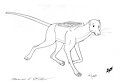
O is for Oxyaena, a genus of carnivorous mammals that hunted about central North America and Eurasia some 56 and 48.07 million years ago during the early Eocene.
It does help, I've got to say that, although as one of several sites. I primarily use Wikipedia and Wikimedia Commons (the latter especially for photos of living animals that help in visualizing bodies of similar extinct animals) as well as looking for paleoart on DeviantArt (I watch a handful of paleoartists there; I imagine without them, I wouldn't have ever gotten to the point of this year's A-Z list).
It does help, I've got to say that, although as one of several sites. I primarily use Wikipedia and
Speaking of paleoartists, I follow a couple, too. I can't remember if they're here or another site, though. If I can remember/find them, I'll give you their names and you can add the ones you don't currently follow if you want.
Speaking of paleoartists, I follow a couple, too. I can't remember if they're here or another site,
I follow two of the artists in your list: Osmatar and WillemSvdMerwe. I even have a drawing that I commissioned from Willem: https://inkbunny.net/s/1913186 I had a chance to have an animal I created to be used in a comic and/or story. I created the Ashtlaka. I wish I'd had a drawing of it when the artist was asking for creatures for his comic. When he saw it, he said that if I had had the drawing when I offered my Ashtlaka, he would have chosen it. Just my bad luck for not being an artist. LOL
I follow two of the artists in your list: Osmatar and WillemSvdMerwe. I even have a drawing that I
Right now, I've only got the following bits of info about it. It's roughly 8 feet tall at the shoulder. The hind legs are shorter than the forelegs to allow it to have more force when it pulls something heavy. It has four eyes because it's a prey animal that needs binocular vision to defend itself from predators and wide-ranging vision to prevent predators from sneaking up on it. Like oxen and other cattle, they have been domesticated by the planet's inhabitants to use as pack animals and to pull plows. The coloration is a form of camouflage. At this time, that's all I know for certain about the species.
Right now, I've only got the following bits of info about it. It's roughly 8 feet tall at the shoul
Thanks. As I originally said, I created the Ashtlaka for an artist to be used in his/her webcomic. Unfortunately, since I'm not an artist, I didn't have any mock-ups of it and the artist chose another creation. However, after getting the Ashtlaka drawn and shown to the artist, I was informed that if I had had the drawing in time, he/she would have chosen my creation. Nice to know, even if it was a consolation prize.
I may use the Ashtlaka in a future story where I delve even deeper into its history and ecological niche.
Thanks. As I originally said, I created the Ashtlaka for an artist to be used in his/her webcomic.