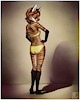
I wasn't sure about her race until I read the keywords. (I don't use the word species on anthros.) I had a feeling she was an o'possum just from the shape of her muzzle and teeth.
I wasn't sure about her race until I read the keywords. (I don't use the word species on anthros.)
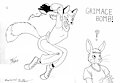
Yes, probably not my best opossum and I probably could have done this gag better, but at least it's passable.
(In my worlds, they don't refer to themselves as species either. They call themselves peoples: opossum people, raccoon people, rabbit people, etc. Race is used for different types of a particular people, just as it is with we humans: squirrels can come in reds or grays; foxes as reds, grays, or arctics; and so on.)
Yes, probably not my best opossum and I probably could have done this gag better, but at least it's
It occurred to me when I was writing about the Treetop Artemins and realized that the different types of squirrels (reds, grays, and so on) would be like real life races to us. Granted, it's not exactly like human races as the squirrels (for example) are different species in real life, but with so many different species/peoples rubbing shoulders, similar ones would be treated more like races than another species. (I have magic gene-fiddling thingummers, origins unknown, to handwave away the furry trope of different species reproducing, like skunk x squirrel = viable offspring. So, in-universe, those different squirrels actually would be races instead of species.)
It occurred to me when I was writing about the Treetop Artemins and realized that the different type
In my story, "There's No Way", since all the anthros are GELFs, using human and animal DNA to create the Humanimal species, all the different "races" can interbreed and create so-called hybrids (although they're as much hybrids as mixed race humans). The only limitations I put on them is that placentals can't breed with marsupials or monotremes and marsupials can't breed with monotremes. This is because of how the different families(?) reproduce, placentals carry their young to term, marsupials give birth to extremely premature young, and monotremes lay eggs. Of course, I do allow them to engage in sex with each other (can't take away ALL their fun. LOL).
In my story, "There's No Way", since all the anthros are GELFs, using human and animal DNA to create
In my Winterfur world, which uses a lot of mythical and legendary real world lore, I handwave it all away as doings by ancient astronauts (thus implying that the peoples of that world are themselves GELFs, albeit my own take), but in my modern day analog world, who the heck knows? After all, there's a lot we don't know about our own origins, be it natural evolution or something else entirely.
In my Winterfur world, which uses a lot of mythical and legendary real world lore, I handwave it al
There are legends that the "gods" came to Earth and literally created humans. Also, as you no doubt know, there are stories from all over the ancient world of half-human/half-animal hybrids (ancient Egyptian gods and goddesses for example). So, who knows for certain.
There are legends that the "gods" came to Earth and literally created humans. Also, as you no doubt
That's true, and it still seems to be going strong through some pseudoscientific circles. I think the big current myth names the ancient astronauts (possibly reptilians? advanced humanoids? It varies) as the Annunaki, a race native to the rogue planet Nabiru. According to Zachariah Sitchin, who popularized the idea, they came to Earth tens of thousands of years ago and uplifted some of the native hominids into Homo sapiens to act as a slave class, building mysterious artifacts and monuments (as if our ancestors were too stupid to have made those things themselves without modern tools) across the world before leave Earth for some reason. Some accounts wedge in one or two other alien races who were effectively on our side (one being the ones behind crop circles).
With no real hard physical evidence to back it up (much of Sitchin's "research" has been shown to have been badly misinterpreted and possibly made up; a lot of the myth is really little more than people letting their imaginations run away with them, much like they did with older Atlantis and Mu myths), it's really no more than pseudoscience passed off as a scientific hypothesis.
That's true, and it still seems to be going strong through some pseudoscientific circles. I think t