Species Profile: Bradyporus crocuta
Common Name: The Hyena-Katydid
Overview:
Bradyporus crocuta is a remarkable species of flightless katydid that has evolved behaviors and physical characteristics strikingly convergent with the Spotted Hyena (Crocuta crocuta). Found in arid, semi-desert, and savanna environments, these large-bodied insects are not solitary herbivores like most of their kin. Instead, they are highly social, pack-hunting scavengers and omnivores that thrive in complex clans.
Physical Description:
Bradyporus crocuta exhibits pronounced sexual dimorphism, a key feature inspired by hyenas.
Size & Structure: These are large, heavily armored katydids with a robust build and powerful, elongated jumping legs. Their overall structure suggests significant physical strength.
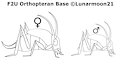
Sexual Dimorphism: As shown in the chart, the female (left) is significantly larger and more robust than the male (right). This size difference is a direct parallel to the female-dominated social structure of hyenas.
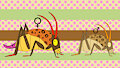
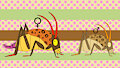
Coloration & Camouflage: Both sexes feature a disruptive spotted pattern on their pronotum and wing cases, mimicking the hyena's coat. This camouflage is highly effective against the dappled light and shadow of the savanna floor.
Head & Antennae: The head is dark and formidable, featuring large, rounded, and expressive eyes, which give them an almost mammalian, curious gaze. Their long antennae are brightly colored, tipped with orange, which may serve as a visual signal within the pack. Their mandibles are immensely powerful, adapted for crushing bones and tough carcasses.
Genitalia: The female possesses a distinctively elongated, purplish ovipositor, which is a defining visual trait. This structure is not just for egg-laying but is also visually reminiscent of the female hyena's pseudo-penis. The male has more subtle, typical katydid terminalia.
Behaviour & Ecology:
The social behaviour of Bradyporus crocuta is its most unique characteristic.
Social Structure: They live in clans with complex hierarchies, dominated by large females. Males are often subordinate. This structure involves cooperation in both defence and foraging.
"Laughing" and Communication: The species is known for a unique, high-pitched stridulatory call that resembles the "laughing" or "giggling" of a hyena. This call is used to communicate clan status, summon pack members to a food source, or signal excitement during pack-level scavenging.
Pack-Hunting Scavengers: While they feed on plant material when necessary, Bradyporus crocuta primarily targets animal carcasses. Clans will swarm a large insect or small vertebrate corpse, using their powerful mandibles to tear off flesh and crush bones. They are also known to engage in kleptoparasitism, using their combined numbers to steal food from other insects or small predators.
Territoriality: Clans defend territories aggressively against neighboring clans. This defense is marked by the "laughing" calls and physical displays of aggression.
Reproduction:
The life cycle is typical for katydids, but the complex social dynamics make mate selection and rearing unique. Females are highly selective, favoring males that prove their strength or clan status through social rituals. Eggs are laid in the soil, and the nymphs are raised within the protective environment of the clan.
Bradyporus crocuta represents a fascinating and bizarre evolutionary path, where the survival strategies of a predator are mirrored by an insect, creating a true "hyena of the grass."
Dominance Hierarchies and Social Enforcement:
Within a Bradyporus crocuta clan, alpha females maintain absolute political and social control through physical intimidation, priority access to high-value protein carcasses, and ritualized behavioral displays. Subordinate males, which rank lower than all adult females and often lower than high-ranking sub-adults, navigate a tense social landscape.
The Dominance Insertion Display
To reinforce rank, suppress reproductive rebellion, and assert physiological supremacy mirroring the pseudo-penis-mediated social sorting of spotted hyenas, dominant females utilize their elongated, specialized terminal structures.
The Act: An alpha or high-ranking female will pin a subordinate or non-compliant male, forcibly inserting her elongated, purplish ovipositor into the male’s anal cavity.
Physiological & Psychological Impact: Far beyond simple physical subjugation, this intromission-analogous display serves as a neuro-hormonal stressor, leveraging tactile sensitivity in the terminal segments to induce submission, submission-signaling postures, and endocrine suppression in the male.
Frequency and Context: This behavior spikes during high-competition events—such as multi-clan carcass partitioning or when a male attempts unauthorized approach to a resource before feeding hierarchy protocol permits. It replaces or accompanies the high-pitched stridulatory "laugh," transforming tactile dominance into a multi-sensory subjugation ritual.
Evolutionary Convergence with Hyena Social Mechanics:
Just as female spotted hyenas use an erectile pseudo-penis for greeting ceremonies, social assessment, and asserting hyper-androgenic dominance, Bradyporus crocuta co-opts egg-laying morphology into an instrument of socio-political policing. This ensures that male physical vigor—necessary for cooperative heavy-load scavenging and perimeter defense—remains strictly subordinated to matrilineal leadership without risking lethal physical elimination of the clan's lower-tier labor force.
Keywords
male
1,312,988,
female
1,194,632,
insect
8,023,
bug
5,643,
dominant female
2,188,
ovipositor
748,
cricket
166,
speculative evolution
80,
speculative biology
73,
katydid
4,
orthopteran
2
Details
Published:
2 months ago
14 Sep 2026 00:34 CEST
Initial: 078acf0ffb0abe989005f368fa369549
Full Size: 041dd30549f127c6277a613e916a1d3e
Large: ee4503e0441c4c707720f115af58357a
Small: adf89d9807b374aa143ee82c0030d9c8
Stats
10 views
0 favorites
0 comments