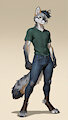
CCD-951-C sat up as her HUD came fully online. She looked around and saw a Gray Fox male.
"You're awake. How do you feel?" he asked.
"Unknown." She examined her repaired arms, rotating them slowly. "I have detected damage to my Positronic Mainframe, and errors within my programming."
She turned to face him fully. "My start-up sequence should have terminated, but I am online."
The Gray Fox stepped closer and set some clothes down next to Weave—black military pants and a gray tank top. "My name is Bob, Bob Mortyn."
Weave took the clothes and put them on.
"I am CCD-951-C. Command Combat Drone, Unit number 951, Model C. The humans I served with would call me Weave."
Bob took a step back. "A CCD? So you were built for combat?"
Weave looked at Bob. "Among other things, yes. I am programmed to lead a squad of reconnaissance-specialized Tethered Combat Drones and to provide emotional, psychiatric and psychological support for Organic Soldiers."
Bob looked at Weave curiously. "It's strange that a combat drone could provide that kind of support for human soldiers."
Weave adjusts the tank top slightly. "The model Cs were the first with that kind of programming."
"The higher-ups thought that it would help with morale, but they refused to give the model Cs the ability to experience emotions."
"They said it was too complex to maintain and the model Ds won't be launched with that type of programming."
She looked at Bob, tilting her head slightly. "Is something wrong?"
He stepped closer, his expression shifting. "What year does your internal chronometer say it is?"
Weave paused. "I don't have an internal chronometer, but my Quantum Matrix says it is still 2269."
The Gray Fox took a step back. His jaw tightened.
"Quantum Matrixes haven't been used for almost 900 years," he said quietly. "They were replaced because they could allow an AI to adapt, and grow beyond their programming."
When Bob spoke again, his voice was careful. Measured.
"It's 3145."
Weave's processors stuttered. The numbers didn't align. Couldn't align. She ran the calculation again. And again.
Eight hundred and seventy-six years.
"I think I have some explaining to do," Bob said.
Bob led Weave into the main cabin. They sat at a table across from each other.
Bob placed a strange, circular device on the table between them. "This is a Navigational Chart."
He activated it. A holographic map of the local system bloomed into existence, casting blue light across their faces.
"We are in what used to be the Sol System," Bob explained.
Weave's optical sensors fixed on the map. "The Sol System used to be the heart of the Allied Fleet."
"The Ferasians launched a full-scale assault and irradiated the atmosphere," Bob continued. "The Allied Fleet fled to the Council Systems and abandoned the system."
Weave stared at the map. Fragments surfaced—not memories, exactly, but data tagged with emotional weight. A Ferasian ambush. Her mobility compromised. Sensors failing, cooling and lubricant mixing in the dry sand.
Weave's hands trembled slightly, a tightness gripping in her chest. Something new.
Her voice was quiet.
"I remember voices, human voices. They were picking things up and tossing them aside."
She felt something wet run down her cheek.
"My emergency power was depleting slowly. My systems were shutting down." Her voice wavered—something new, something she didn't have a designation for. "I saw a green flash in the sky, then my emergency sub-systems took over."
"The next thing I remember is seeing the sky again."
"I could hear birds singing in the distance. Then I heard your voice."
Bob moved and sat next to Weave, gently placing a hand on her arm.
He gently wipes her cheek. "I suppose a lot has happened to you."
Bob switches off the navigational chart. "At least you're still functional."
"Think of this like a second chance."
---
The cabin door suddenly flew open with a bang.
A petite anthro rat woman rushed in, shouting, "Bob! Bob!" She scurried across the floor, clutching a bag to her chest. "Keep shinnies safe, keep shinnies safe."
She skidded to a stop in front of Bob and Weave, squeaking with delight. "Bob? Metal dog fixed?"
Bob smiled. "Scratch, this is Weave."
Scratch moved closer, tilting her head. "How metal dog feel?"
Weave looked at the small Rodkin woman. She placed a hand on her chest, uncertain. "I feel..." She paused. A small chuckle escaped her—involuntary, strange. "I'm not sure."
"I've never felt emotions before," Weave admitted.
Scratch placed a small hand on Weave's leg. "Scratch and Bob help Weave."
---
"Scratch, what shinnies did you get today?" Bob asked.
Scratch opened her bag to reveal a few old coins and several micro-servos. Bob picked one up, examining it.
"These would be compatible with Weave's parts," he said. He looked at Weave. "Scratch found most of the compatible parts we used to repair you."
Weave turned to the small Rodkin. "Scratch, I wouldn't be as functional as I am without your expertise and knowledge."
Scratch's ears drooped. She shook her head, smiling. "Weave has big words."
"Big words okay," Scratch said. "Scratch not use big words. Scratch like small words."
Bob gently patted Scratch's head. "Most of the Rodkin can't talk very well. But they are extremely intelligent—perfect for engineering and maintenance."
Weave tentatively reached out and patted Scratch's head. "Well Scratch, looks like I'll need your help if I want to stay here."
She looked at Bob. "I have a lot of catching up to do."
Then back to Scratch. "Scratch? Could you find an Internal Chronometer that would be compatible with my systems?"
Scratch's eyes lit up. She bolted toward the garage and returned a few minutes later holding a box. "Spin clock."
Weave opened the box carefully. Inside lay a gyroscope, its brass frame catching the light.
"A Gyroscope?" Weave lifted it, turning it over in her hands. "That could work."
"The Model As used Gyroscopes coupled to a clock to track the planet's rotation," she explained. "They stopped using them when the Model Bs were launched, switching to a fully digital method."
She inspected the device more closely. "Gyroscopes would 'drift' over time, making them unreliable in the long run."
Scratch tapped Weave's head. "Weave brain fix drift?"
Weave smiled. "Yes. My automated repair system would correct the drift in real time."
Bob put his hands on both their shoulders. "That's a job for tomorrow. First, we should eat."
Scratch scurried into the kitchen, shouting, "Scratch good cook! Scratch make special food!"
Bob guided Weave to the dining table. "She'll bring the food when it's ready."
After about an hour, Scratch pushed a cart laden with pots into the dining area. "Food," she announced.
She served stew into bowls. "Scratch catch fast lizard. Make stew."
Bob looked at Weave apologetically. "Weave, I'm sorry. I didn't even think to ask if you could eat."
Weave accepted a bowl and took a spoonful. The flavors registered—complex, warm. "I have micro bio-reactors that can process organic matter, turning it into power."
She looked at Scratch. "It tastes good."
"Normally the bio-reactors are for emergencies only," Weave continued, "but they can theoretically sustain my functions when used alongside a daily charging cycle."
Scratch and Bob ate their stew. Scratch asked, "Weave eat and sleep?"
Weave chuckled. "I suppose I do."
Bob looked at Scratch. "Scratch? Are those power cells still in the garage?"
Scratch ate a spoonful of stew. "Zap box still on shelf."
She looked up at Bob. "Sun make zap box strong?"
Weave tilted her head. "Solar powered batteries?"
"Yes," Bob responded. "Tomorrow we can hook up the power cells to the solar panels. We're in a desert, so we get around twelve hours of sunlight a day."
The three of them spent the next few hours finishing the stew and discussing their plans to create a reliable, sustainable power source.
Scratch yawned wide, her small hands covering her muzzle. "Scratch tired. Good sleep now."
She hopped down from her chair and padded toward the hallway, pausing to look back at Weave. "Weave sleep good too."
"Goodnight, Scratch," Weave said softly.
Bob watched the Rodkin disappear down the hall, then stood and gathered the empty bowls. "Want to sit outside for a bit? The stars are clear tonight."
Weave followed him out onto the cabin's small porch. The desert stretched endlessly before them, bathed in silver moonlight. Bob settled onto the weathered bench, and after a moment's hesitation, Weave sat beside him. The wood creaked under their combined weight.
The silence between them felt different than the comfortable quiet they'd shared before—heavier somehow, expectant.
"Can I ask you something?" Bob's voice was low, almost hesitant.
"Of course."
"What do you miss? From before, I mean. From your time with the Allied Fleet."
Weave's optical sensors dimmed slightly as she processed the question. No one had ever asked her that before. What she missed. What she wanted. What she felt about anything beyond tactical assessments and mission parameters.
"I miss..." She paused, searching for words that had never been required of her. "I miss having purpose. Knowing exactly what was expected of me. But I don't miss what that purpose was."
Bob turned to look at her, his weathered face thoughtful in the moonlight.
"I was designed to provide psychological support," Weave continued, her voice quieter now. "To the soldiers under my command. I would listen to their fears, their doubts. Hold them when they broke down. Tell them they mattered, that they were valued." Her hands rested in her lap, fingers interlacing. "But no one ever asked me what I needed. What I feared. If I mattered beyond my function."
"That sounds lonely," Bob said simply.
The word struck something deep in her processing core. Lonely. Yes. That was what it had been.
"I didn't know it was loneliness then. I couldn't feel it. But now\..." She looked down at her hands. "Now I think I was always lonely. I just didn't have the capacity to understand it."
Bob was quiet for a long moment. When he spoke again, his voice carried a weight she hadn't heard before.
"I know something about loneliness." He leaned forward, elbows on his knees, staring out at the desert. "Eleven years ago, I was with a mercenary company. Had a partner—someone I loved. We had a daughter together." His jaw tightened. "We were heading to a station to refuel when pirates hit us. Ship went down hard on some backwater planet."
He was silent for a moment, and Weave could see his hands clench.
"I was the only one who made it out of the wreckage." His voice went quieter. "Spent weeks trying to find them in the debris. But there was nothing left to find."
Bob exhaled slowly, the sound heavy with old grief.
"Came back to Earth because I didn't know where else to go. Got this cabin. Spent a year just... existing. Going through the motions." He glanced back toward the cabin. "Then I found Scratch in a scrapyard, trying to fix a broken generator twice her size. She was maybe ten years old, alone, surviving on scraps and her own cleverness."
A faint smile crossed his face, though his eyes remained distant.
"Took me five years to officially adopt her. Kept telling myself I wasn't ready to be responsible for someone again. But she didn't give me a choice—just kept showing up, kept fixing things, kept dragging me back into the world." He shook his head. "She saved my life. Gave me a reason to keep going when I didn't have one anymore."
Weave felt something tighten in her chest—that strange sensation she was still learning to identify. Empathy, perhaps. Or something deeper.
"I'm sorry," she said, and meant it with an intensity that surprised her.
"Me too." Bob turned to look at her again, and their eyes met. "But I'm not sorry you're here now. That we found you."
The way he said it—the quiet sincerity, the warmth in his gaze—made Weave's systems register something she couldn't quite categorize. Her cooling fans activated unnecessarily. Her optical sensors refocused multiple times.
"I'm not sorry either," she said softly.
They sat in silence again, but this time it felt different. Closer. Bob's hand rested on the bench between them, and Weave found herself acutely aware of the distance—mere inches—that separated them.
"Bob?" Her voice was barely above a whisper.
"Yeah?"
"Thank you. For asking what I miss. What I fear. For..." She struggled to find the right words. "For seeing me as more than what I was built to be."
Bob's hand moved, covering hers. The warmth of his skin against her synthetic palm sent data cascading through her sensors—temperature, pressure, texture. But beneath all that, something else. Something that made her want to stay exactly where she was, in this moment, with this person who had asked her what she needed.
"You're not a function, Weave," Bob said quietly. "You're family. And maybe..." He paused, seeming to weigh his next words carefully. "Maybe something more than that. If you want to be."
Weave's processors struggled to parse the implications, the possibilities contained in those simple words. But her hand turned beneath his, fingers curling gently around his palm.
"I think," she said slowly, "I would like to find out what that means."
They sat together under the stars, hands intertwined, neither quite ready to name what was growing between them—but both feeling it nonetheless.
Bob points up to a small blinking light in the sky. "There. See that?"
Weave follows his finger. "The blinking light?"
Bob lowers his hand. "When I was a pup, I would look up at that blinking light and promise myself that, one day, I would fly to that star in my own ship"
Bob chuckles "When I did finally get up there, I saw that it was just an old satellite."
Weave looks at Bob. "It was more than just an old satellite. It was a dream, your dream."
Weave looks back up at the sky, unsure if what she said came from her programming, or if it was from something more.
Bob looks up at the blinking light again. "You're right, it was never just an old satellite."
"Did you ever look up at the stars and wonder what was up there?"
Weave looks at Bob. "I had access to hundreds of Exabytes of data. I knew everything the Allied Fleet mainframe had access to"
"But now" Weave looks up at the stars "Now\...it's a new sky, one I know nothing about"
"I think I feel scared, maybe nervous, of what is out there now."
Bob gently squeezes Weave's hand. "At least you won't have to face it alone."
"We should head back inside. It's starting to get colder"
Bob and Weave head back inside.
Bob leads Weave to a bedroom. "Here, this room is yours"
Weave opens the door and looks inside. "A room for me?"
She turns to face Bob "Thank you. And, good night."
Weave heads into her room, Bob stops just at the doorway. "My room is at the end of the hall, if you need anything."
"Good night Weave." Bob heads into his own room and Weave closes her room door, but not fully.
She has a look around the room, talking to herself
"A bed, a wardrode, a desk and a dresser."
She opens a door. "Even a small washroom, with a shower."
"I'll need to try the shower in the morning"
She closes the washroom door and moves to the bed. She removes her clothes and lies down, pulling the quilt up to her shoulders.
She closes her eyes and her systems slowly start to enter power-saving mode, leaving only her critical systems running.
Her memory banks start to activate, replaying memories from her past. They begin to shift to something softer and gentler, her brief time with Bob and Scratch.
Weave sees a glimpse of something new. She starts to dream.
She was sitting on a chair, gently cradling something. Something she felt was extremely precious, something irreplaceable. She could hear Bob fixing the truck and Scratch cooking. She got up from the chair and moved to a series of photos. The photos were blurry, she couldn't quite make out the faces, but she could make out a gray fox and a fennec fox on their wedding day. She looked down at what she was cradling—two newborn pups, one gray fox and one fennec fox. She looked up at the wall behind the photos, adoption forms for the two pups proudly framed.
She returns to the chair and sits down.
She has a family and she is home.