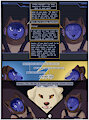
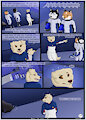
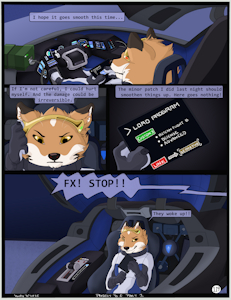
Yup! They definitely got caught. Thankfully nothing bad happened on their little escapade to Canis Major. But now they are back in the Prototype D.E Cruiser and things are about to get a bit intense. Hopefully Captain Kalem is just tired and in a bad mood. After all, it's like 4am and they all need to be up early that same morning. But what's that? Someone forgot to hide that mysterious device properly...
'Wreckless' isn't a word, and if it was a word, it would mean something without wrecks (or something that does not cause wrecks). Which ironically would have the exact opposite of the word 'reckless' 😛
GTHusky ( https://inkbunny.net/GTHusky ) – Just FYI the correct word is *'reckless'* ( https://www.
You’re right that reckless is the normal word and “wreckless” is usually just a typo. But “wreckless” isn’t completely made up.
It actually shows up here and there as a super rare word built from wreck + -less, basically meaning “without wrecks.”
You can even find a few old writers using it on purpose, which is why some dictionaries still bother to list it.
So in everyday English you should always write reckless, but it’s not totally correct to say “wreckless isn’t a word” it’s more like a weird little side-branch of the word that almost always looks like a mistake.
You’re right that reckless is the normal word and “wreckless” is usually just a typo. But “wreckless
I'm all for the view that English is a constantly evolving language and that a strictly proscriptive approach to spelling or vocabulary is both unrealistic and needlessly stilted. Perhaps it would have been more correct for me to say that 'wreckless' is clearly not the correct word in this scenario, and that the author clearly used it as a typo rather than intentionally as some kind of creative side-branch.
That being said, I have personally never encountered 'wreckless' used anywhere in an intentional sense, and wonder whether you are perhaps getting confused with the similar-sounding but nonetheless totally different word 'wreakless'? Because that word is archaic and is derived from the root word 'wreak' in its archaic meaning of 'to avenge', rather than the more modern meaning of the word 'wreak' as in to violently or dramatically inflict something (like 'wreak havoc upon').
I'm all for the view that English is a constantly evolving language and that a strictly proscriptive
There’s a recorded use of it in 1822 in a piece by Lord Byron, where he talks about an ark with “safe and wreckless sides,” so the word has at least early‑19th‑century roots in print, not just modern typos.
Over time, though, English settled on reckless (from Old English reck = “care”) as the standard word, and wreckless basically faded into obscurity and now mostly pops up as a misspelling.
So yeah, it’s rare and confusing, but it does have a traceable origin and a couple centuries of very occasional use behind it.
There’s a recorded use of it in 1822 in a piece by Lord Byron, where he talks about an ark with “saf